
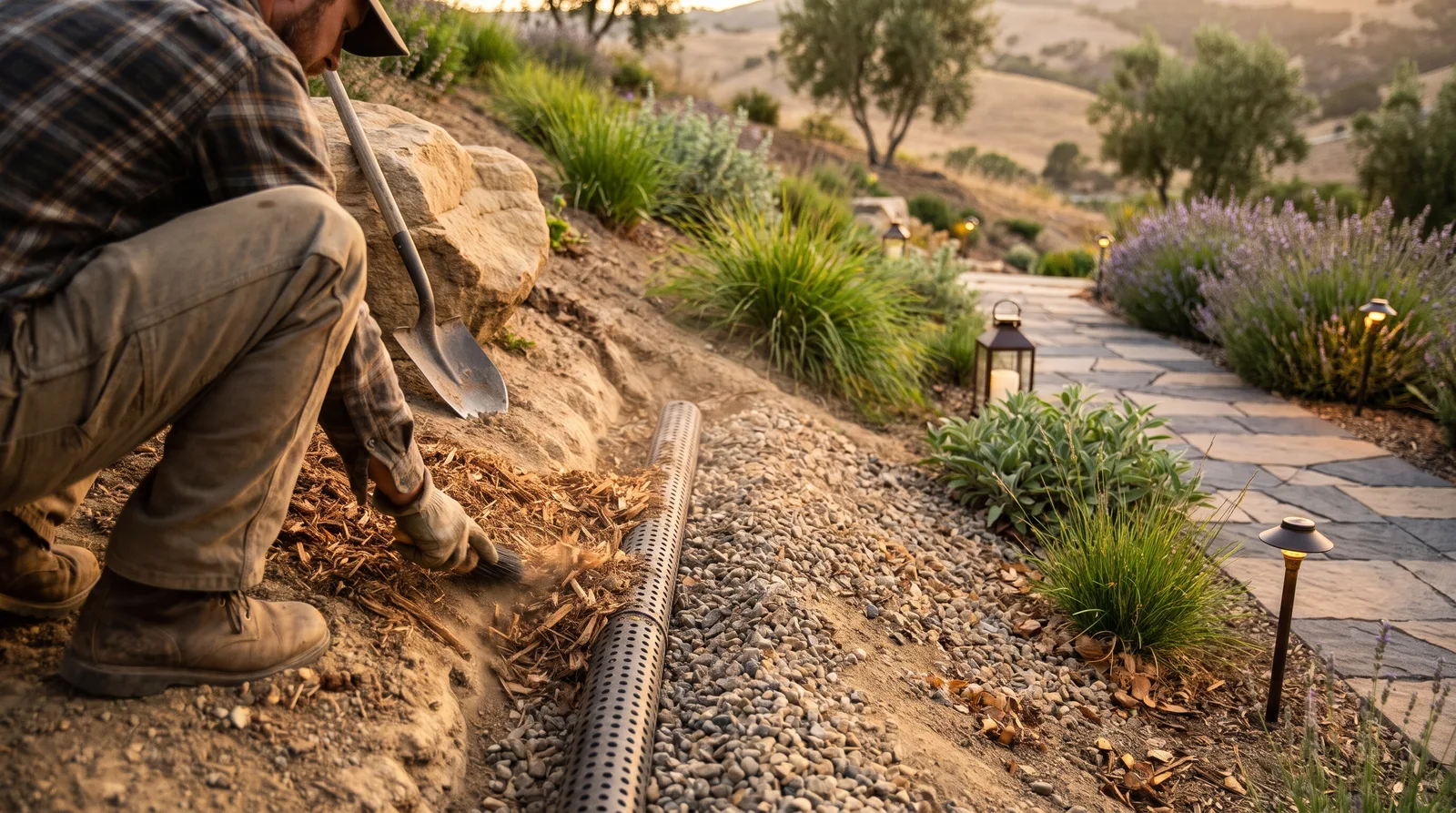
 hillside drainage
Hillside Drainage in Rancho Bernardo: Why Slopes Fail
Anthony Criss · November 22, 2026
Key takeaways
Slopes in Rancho Bernardo mostly fail when water saturates clay-rich soil that can't drain.
Many failures start with water people add: a broken irrigation line, roof runoff or an old storm pipe.
A sound plan intercepts water above the slope, carries it in a pipe or lined channel, and protects the outlet.
Retaining walls over 3 feet, steep backfill or surcharge loads need a City permit and engineering.
Hillside drains are usually the owner's job to maintain, so clear them before October.
Hillside slopes in Rancho Bernardo usually fail because water soaks into clay-rich soil and has nowhere to go. A good drainage plan intercepts that water above the slope, carries it in a pipe or lined channel to a safe outlet, and protects the slope face with roots and proper irrigation.
At AJ Criss Industries, we build and repair drainage for North County homeowners, and the pattern is consistent: the slope is rarely the root problem. Water is. Here is why slopes fail, how a drain plan is built, and when you need an engineer or a permit.
Why slopes fail in Rancho Bernardo
Landslides are the most common naturally occurring type of slope failure in San Diego, according to the City's General Plan geology review. That same document says they tend to occur in sedimentary rock such as sandstone, siltstone and claystone, which often weather to clay when exposed to air and water. It lists portions of Rancho Bernardo among the City areas where landslides have occurred.
It also names local formations made of expandable clays, and notes that saturated clay seams can cause slides even on gentle slopes. In plain terms, wet clay swells, loses strength and gets slick. Dry clay cracks, which lets the next rain soak in faster.
Grading matters too. The same report says a slope can be destabilized by cutting material from the bottom, making the slope taller, or adding fill at the top. Steep manufactured slopes with shallow-rooted plants on thin topsoil can turn liquid when saturated.
Where the extra water comes from
Rain is only part of it. The City's geology review lists septic water, gutter runoff and diverted drainage from another part of the slope as common ways people saturate a hillside. Small sources can do real damage.
One City hearing officer report describes a slope about 60 feet high at 1.5:1 that failed after a broken irrigation line above it. The report states the damage came from the broken line, not from instability of the hillside itself.
Buried pipe is another culprit. In one City case, a failing 18-inch storm drain behind a property was tied to sinkholes and slope failure. In another, a camera inspection showed a 24-inch pipe completely corroded under a sinkhole 5 to 10 feet deep. A third case involved an undersized 12-inch storm drain that was replaced with about 590 feet of 18-inch pipe.
Irrigation leaks and overspray above the slope
Downspouts and roof runoff dumped onto fill or slope faces
Patio, driveway or walkway runoff pointed downhill
Old or undersized storm pipes and a neighbor's flow
How a hillside drain plan is built
We build the plan in a set order, because skipping a step usually moves the problem downhill.
1. Walk the site and find the water paths
We look at where water enters, where it travels and where it leaves, ideally during or just after rain. We check roof drains, irrigation and existing pipes. This diagnosis step is the same one we describe in our guide to finding the cause of drainage problems.
2. Intercept water above the slope
The County's guide says a small drain can be dug at the top of each steep slope to divert water, and that large amounts shouldn't build up along one route. In the County's homeowner guide, a slope or bench drain is typically a V-shaped ditch covered in gunite or concrete, about 3 to 5 feet wide and 12 inches deep.
The County's grading rules take the same view: slopes are protected from runoff above by berms, swales or brow ditches unless the County says they aren't needed. Those rules cover unincorporated areas, but they show how engineers think.
Surface drains, subsurface drains and safe outlets
As a general rule of practice, surface drains such as swales and lined ditches handle runoff, while subsurface drains such as French drains and wall drains handle water moving through the soil. Most hillsides need both. This distinction is common practice, not something from the sources above.
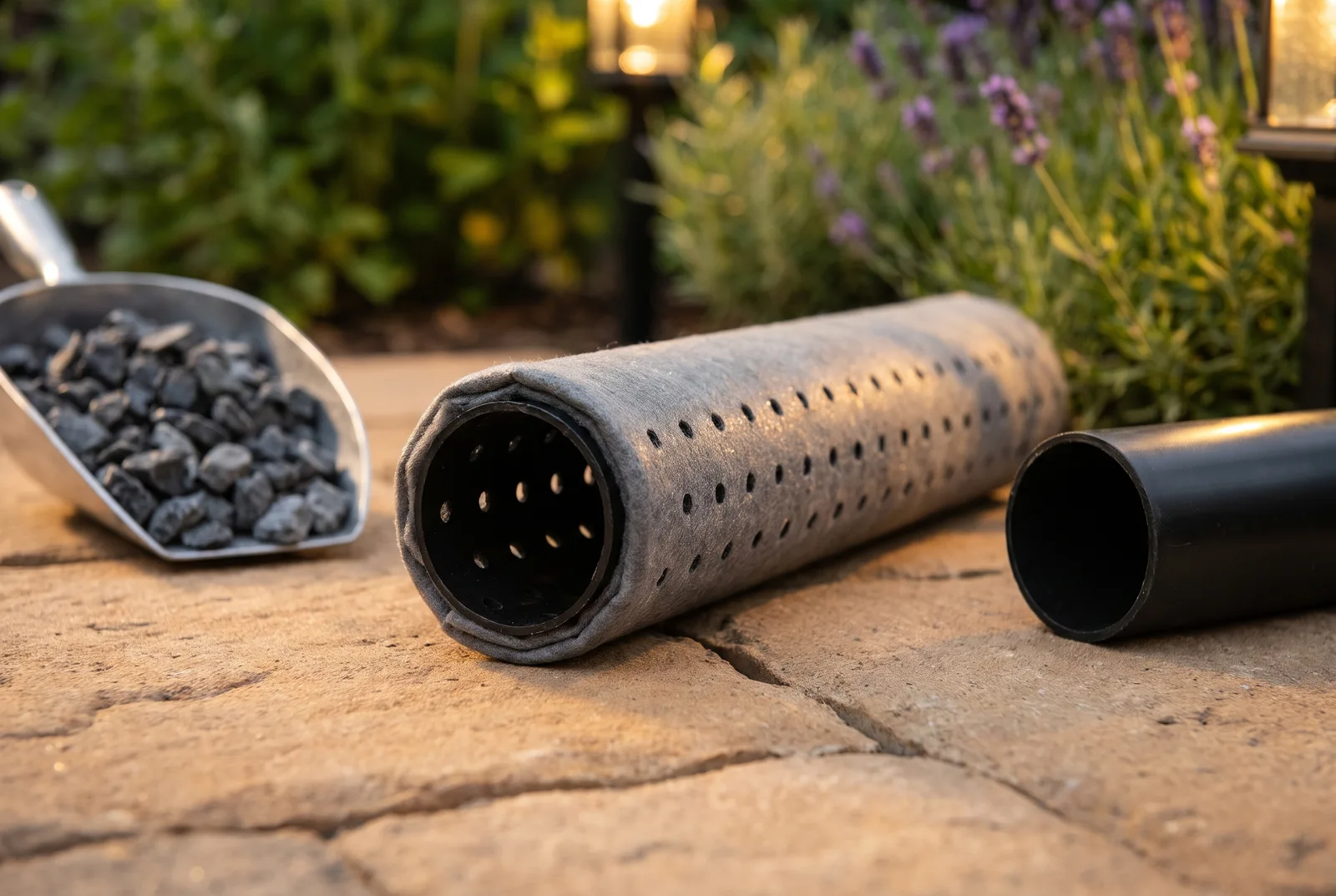
Every drain needs a safe place to end. The County's amending ordinance calls for swales at a minimum 2 percent grade and 1 foot deep, with discharge points protected from erosion. Check current code before relying on those numbers. A pipe that dumps onto bare soil just starts a new gully.
Behind retaining walls, the usual approach is gravel backfill with a perforated pipe that leads to an outlet. We cover this in more detail in our article on hillside retaining wall drainage and footings, and our drainage installation service handles the pipe, grading and outlet work.
What not to use on a slope
The County guide says sandbags shouldn't be used on a slope, and silt fences aren't meant for slopes either. Gravel bags, placed across the slope and no more than two high, are the option it gives. It also says it is unlawful to divert natural flows onto a neighbor's property, and that water needs to go somewhere, so devices should deflect flow rather than dam it.
Protect the slope face
The County guide calls planting the long-term answer to erosion and typically the easiest way to prevent it. Ditches in loose soil should be planted with perennial grasses and ideally drain into a well-vegetated area. Deep-rooted cover holds soil in a way bare ground and thin turf can't. See our guide to groundcovers and soil prep.
Irrigation needs care here. County code requires check valves in slope irrigation systems to prevent erosion from low sprinkler heads draining. A leak above a slope is exactly the failure described earlier, so our sprinkler and irrigation work on slopes focuses on zoning, matched rates and leak checks.
Permits, engineers and what you're responsible for
Rancho Bernardo is inside City of San Diego limits. Under the City's retaining wall bulletin, a wall needs a permit if it is over 3 feet tall (top of footing to highest point), holds backfill steeper than 1.5:1, or carries surcharge loads such as driveways, walkways or fences. Walls like those need their own engineering.
If a slope is actively moving, or a wall or grading change is involved, bring in a geotechnical or civil engineer. That is the honest call, and the County guide advises the same for hard cases. We work alongside engineers when a job calls for it.
Maintenance is usually yours. The County guide says hillside drain upkeep is typically the property owner's responsibility, and blocked drains can cause undermining, structural failure or more erosion. Clear drains and outlets before October, since the rainy season typically runs October 1 to April 30, and again after big storms. Our rainy season yard checklist walks through it.
Common questions
What is drainage correction?
It means finding why water collects or flows where it shouldn't, then changing grading, drains or pipes to move it safely away. On a hillside, that includes where the water ends up. Our drainage repair service starts with diagnosis.
Are French drains used on hillsides in San Diego?
Yes, often for water moving through soil, such as behind a wall. They work best paired with surface drains and a protected outlet. If one is slow, our French drain checklist shows how to test it.
Do I need a permit for a hillside retaining wall in Rancho Bernardo?
In the City of San Diego, yes if the wall is over 3 feet, retains steep backfill or supports surcharge loads. Check with the City before building. Our retaining wall FAQ covers how height is measured.
Can I fix a failing retaining wall without rebuilding it?
Sometimes, if the cause is blocked drainage and the wall hasn't moved much. If it is leaning or cracked, a rebuild may be needed. See when repair is enough.
Start with the water, not the slope
A stable hillside depends on controlling where water enters, travels and exits. Fix the source, intercept above the slope, pipe it to a protected outlet, and plant the face. If you're in Rancho Bernardo, Escondido or anywhere in North County, you can request a drainage assessment from AJ Criss Industries and we'll walk the slope with you. — Anthony Criss
Sources
3.4 Geologic Conditions Draft General Plan City of San Diego Final PEIR 3.4-1 — City of San Diego
THE CITY OF SAN DIEGO REPORT TO THE HEARING OFFICER HEARING DATE: — City of San Diego
THE CITY OF SAN DIEGO M E M O R A N D U M DATE: April 27, 2020 TO: — City of San Diego
THE CITY OF SAN DIEGO M E M O R A N D U M DATE: July 31, 2023 TO: — City of San Diego
MEETING DATE: January 17, 2025 HCR25-002 SUBJECT: — San Diego Housing Commission
Homeowner’s Guide for Flood, Debris, and Erosion Control — County of San Diego
SAN DIEGO COUNTY GRADING ORDINANCE ___________________________________________ — County of San Diego
ORDINANCE NO. 9634 (N.S.) AN ORDINANCE AMENDING THE SAN DIEGO COUNTY CODE, — County of San Diego
DIVISION 7. GRADING, CLEARING AND WATERCOURSES* — County of San Diego
How to Obtain a Permit for a Retaining Wall Using the City of San Diego Standard Drawings and Specifications — City of San Diego Development Services Department