
 groundcover
Groundcover for Slopes and Erosion Control in North County
Anthony Criss · November 27, 2026
Key takeaways
Dense, deep-rooted groundcovers and low shrubs hold a slope best, with mulch or netting protecting them until they fill in.
Fix the water first: plants cannot hold a slope with a runoff channel cutting across it.
State rules bar turfgrass on slopes steeper than 25%, so grass is rarely the answer on a hillside.
Fire-safe planting does not mean bare dirt; the County says some vegetation is needed to prevent erosion.
Steep slopes often need terraces or retaining walls, which is work for a licensed contractor.
The best groundcover for a slope in North County is a mix of dense, deep-rooted groundcovers and low shrubs, protected with mulch or netting while they fill in. Fix drainage first, because plants will not hold a slope with water running across it. Keep turf off anything steeper than 25%, and match the fix to how steep the ground really is.
Below is how we approach slope groundcover and erosion control in Escondido and the rest of North County: where the water comes from, what to plant, how fire rules change the picture, and when to bring in a pro. For the broader planting basics, see our guide to groundcovers for San Diego County yards.
Why North County slopes erode
According to The Water Conservation Garden, San Diego County's heavy clay soil is vulnerable to both rain and wind erosion. It is not porous enough to absorb a winter downpour, and without enough vegetation it will not stay put in summer Santa Ana winds. The result is gullies, slumping and lost topsoil.
The same source calls vegetation the best long-term fix. Grasses, ground covers, shrubs and trees break the force of rain, slow runoff and shield soil from wind. A bare slope has none of that protection, which is why a cleared hillside tends to fail the first hard winter.
Step one: control the water
Before choosing a single plant, find out where the water is coming from: the roof, a downspout, a neighbor's lot, or the edge of a patio or driveway. UC Marin Master Gardeners note that drainage runoff is the biggest hillside concern, and suggest berms to send water around the house. General California guidance, not San Diego-specific, but the logic holds here.
In our experience, most failed slope plantings were doomed by a concentrated flow nobody diagnosed. Start by making sure gutters are tied in, using our guide to connecting downspouts to drain systems. If water still collects or channels, our drainage installation work and the hillside drainage checklist explain how we find, intercept and pipe it to a safe outlet.
Match the fix to the slope
This is our own rule of thumb from the field, not a code table. Gentle slopes can hold with plants and mulch. Moderate slopes usually need erosion blankets or netting on top of that. Steep slopes often need terraces or retaining walls to level off areas so rain soaks in rather than runs off.
Gentle: groundcovers, low shrubs and a layer of mulch.
Moderate: add jute or straw blankets, or wattles, until roots take hold.
Steep: terrace with retaining walls, then plant above and between them.
UC Marin advises leaving terracing to a licensed contractor, and we agree. Walls come with footings, drainage and sometimes permits, which we cover in our hillside retaining wall guide.
Choosing ground covers for San Diego County slopes
On a slope, you want plants that root deeply and cover the surface. UC Master Gardeners in Contra Costa County say deep-rooted shrubs are good, but aggressive groundcovers that crawl and root along the surface are best at reducing topsoil loss. Mulch absorbs raindrop impact and slows runoff.
The Water Conservation Garden recommends planting slope shrubs 3 feet apart with a sturdy cover in between. Mix species rather than betting on one, stagger the placement, and start with small plants such as plugs or 4-inch pots, which are easier to set on steep ground.
Plants worth considering
The Fire Safe Council's plant list includes coyote bush, Ceanothus, manzanita, Lantana, Myoporum and rosemary among its groundcovers. It also lists beach carpet saltbush, a low 6-inch spreading cover that is good for erosion control. The list is several years old, so confirm picks with your nursery or contractor.
A caution on ice plant and Algerian ivy: older articles still push them, and some treat ice plant as a safe fire-resistant choice without caveats. Do not assume any plant is a free pass. Whatever you choose, match it to your sun, soil and irrigation, whether you are in inland Escondido or looking at groundcovers in Rancho Santa Fe.
Fire zones and slopes: bare ground is not the answer
The County's defensible space page describes three zones. Zone 0 is 0 to 5 feet from the house and should be hardscape with nothing that can burn. Zone 1 is 5 to 50 feet and needs low-growth, fire-resistant, irrigated plants. Zone 2 is 50 to 100 feet and needs medium-height, fire-resistant plants.
That does not mean scraping the hill bare. The County's rural fire protection handout says some vegetation is needed to prevent erosion, and that no plant is totally fire resistant. Pick low-growing plants and keep dead material cleared.
Next to the house, pavers, flagstone and walls do the job plants cannot. See our explainer on Zone Zero for North County homes and our interlocking pavers work.
Planting and irrigating a slope
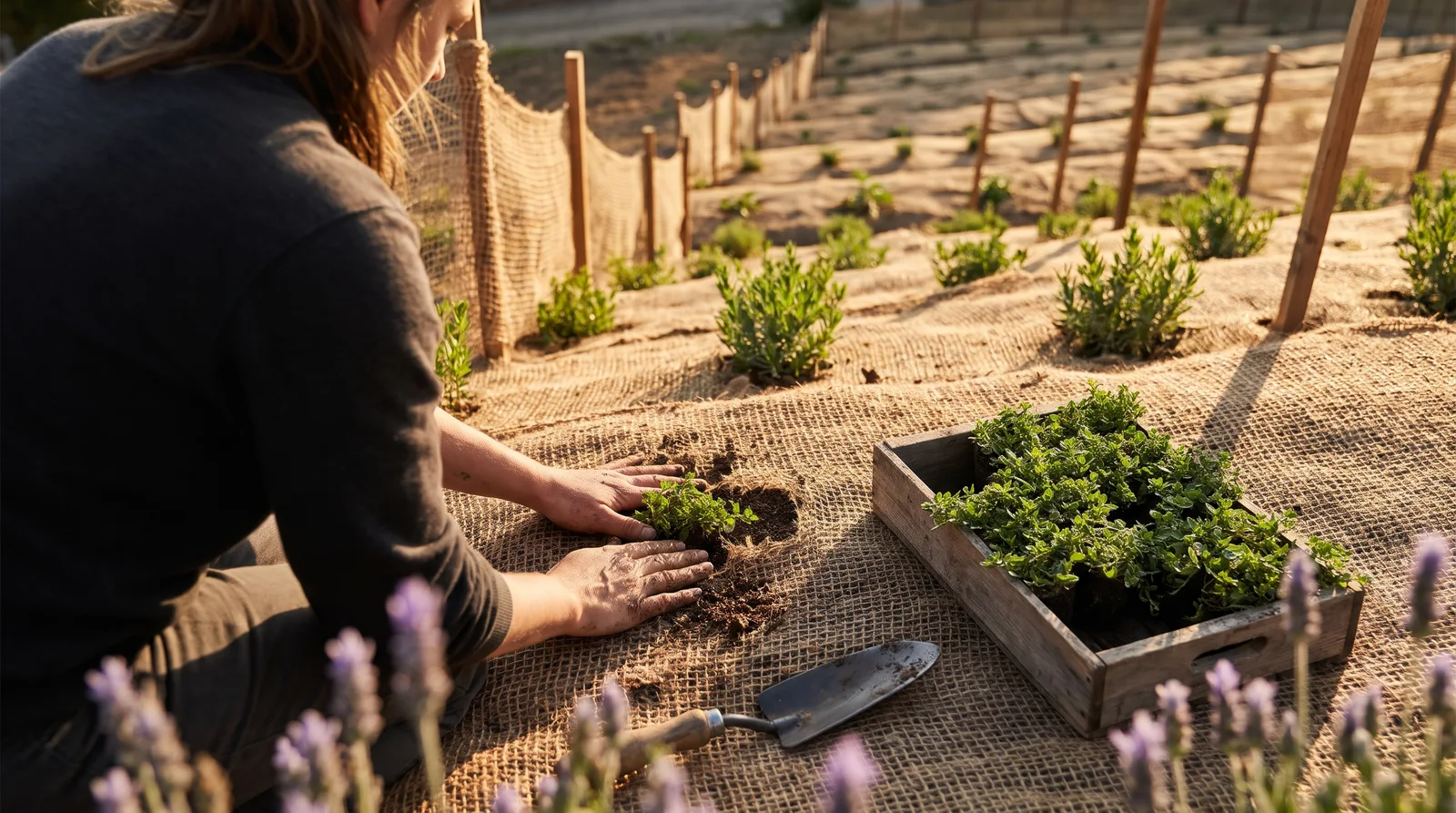
Plant young plants through the cover, not instead of it. The County's Water-Efficient Landscape Design Manual requires manufactured slopes to be covered within 10 days of finishing grading, using hydroseed or mulch, punched straw mulch, or jute netting or another approved geotextile.
UC Marin also points to temporary controls like wattles for the first couple of years, until roots establish. Put them in before the rains, not after the first gully forms. Avoid compacting the soil, and use set paths for maintenance.
Turf and irrigation limits
California's Model Water Efficient Landscape Ordinance bars turfgrass on slopes steeper than 1 foot of rise per 4 feet of run (25%). Slopes over 25% may not be irrigated above 0.75 inches per hour unless the designer shows there will be no runoff or erosion. The state's MWELO guidebook explains the turf ban is meant to prevent irrigation runoff and protect workers during maintenance.
The ordinance applies mainly to new and rehabilitated landscapes above certain size thresholds, so check how it applies to your project. In practice, slow drip irrigation suits a slope far better than spray heads. Our guide to sprinkler and smart irrigation installation in Escondido covers the options.
When to call a pro
Call a contractor if water is cutting channels, the slope has already slipped, or you are considering walls or regrading. Cut-and-fill work and taller walls may need engineering and permits, and thresholds vary, so confirm with the County or your city before you build. We cover how to vet one in hiring a retaining wall contractor in San Diego County.
AJ Criss Industries handles drainage, retaining walls and landscaping across North County, and we can look at your slope and tell you what it needs. Get a quote to start.
Slope and groundcover FAQ
Can I keep grass on my slope?
Not if it is steeper than 25%. State rules bar turfgrass on slopes steeper than 1 foot vertical per 4 feet horizontal. On gentler ground, sod can work if drainage is right; see our sod installation guide.
What holds soil better than grass?
A mix of deep-rooted shrubs and surface-rooting groundcovers under mulch. The roots bind the soil at different depths, and the canopy blunts rain impact. Mixed plantings also survive better than a single species.
Do I need a permit for a slope retaining wall?
It depends on wall height, location and what it holds back. Rules differ by city and the County, so check before building. Our Escondido retaining wall FAQ explains how height is measured and when permits come into play.
How do I prepare the ground before planting?
Fix drainage, loosen compacted soil, and avoid leaving a smooth, slick surface that water sheets across. Then plant small plants and cover the soil right away. Our groundcover prep and planting guide has more.
Start with the water, then plant
A slope holds when the water is managed, the plants are dense and deep-rooted, and the soil is covered while everything fills in. Respect the fire zones, skip turf on steep ground, and use walls where plants alone will not do the job.
If you would rather have a crew assess it, AJ Criss Industries is family-run and works throughout Escondido and North County San Diego. Browse our gallery or reach out for a look at your hillside.
Sources
Avoiding Erosion - The Water Conservation Garden — The Water Conservation Garden, Cuyamaca College
Hillsides — University of California Marin Master Gardeners (UC ANR)
Keeping your Hill in Place: Erosion control on hillsides — UC Master Gardener Program of Contra Costa County (UC ANR)
Fire-Resistant Plant List — Fire Safe Council of San Diego County
Create defensible space - County of San Diego — County of San Diego
Providing enough fire protection for rural areas of San ... — County of San Diego Department of Planning & Development Services
PDS (06/20) DEPARTMENT OF PLANNING & DEVELOPMENT SERVICES — County of San Diego Department of Planning & Development Services
Model Water Efficient Landscape Ordinance (MWELO) — California Department of Water Resources
1 H1/ 2015 Model Water Efficient Landscape Ordinance Guidebook ISBN Copyright — California Department of Water Resources