
 sprinkler repair
Sprinkler Repair in Escondido: Common Failures and Fixes
Anthony Criss · November 19, 2026
Key takeaways
Most Escondido sprinkler problems come from broken or misaligned heads, clogged nozzles, leaking valves or lines, bad pressure, and wrong schedules.
Run every station monthly and do a full spring check; Escondido requires leaks to be repaired as soon as they are discovered.
A two-hour meter test can reveal a hidden leak before it shows up as a soggy spot.
Wet ground is not always an irrigation leak; drainage problems look the same, so test before you dig.
When a system needs repeated repairs, matched nozzles, drip for beds and a rezoned layout often beat patching.
Most sprinkler failures in Escondido come down to a short list: broken or misaligned heads, clogged nozzles, a leaking valve or line, pressure that is too high or too low, and a schedule that no longer fits the season. You can find most of them by running each station once a month and looking closely. Fix leaks quickly, because Escondido's water conservation rules require repairs as soon as a leak or line break is discovered.
Below, we walk through the local rules, the common symptoms and what causes them, how to find a hidden leak, a seasonal checklist, and how to tell an irrigation leak from a drainage problem. That last one is where we see homeowners waste the most money.
Escondido's irrigation rules in plain language
The city's water conservation page sets the basics. Irrigation is allowed only between 6 pm and 10 am. Watering during rain, or within 48 hours of rain, is prohibited. Irrigation water can't run off your property, and leaks and line breaks must be fixed as soon as they are found. The same page also prohibits washing hardscape with a hose, which matters if you have pavers or a driveway.
Rules change with water-shortage levels, so check the city page before assuming anything is permanent. Ignore older news about assigned watering days; that system ended years ago. If you see waste in your neighborhood, the city's Public Works line is 760-839-4668.
Common sprinkler failures, their causes and fixes
Every symptom has a cause, and the fix depends on the cause. Here are the ones we see most in North County yards.
Fine mist instead of spray
Misting almost always means pressure is too high for the nozzle. The EPA's home maintenance guidance says high pressure can call for a pressure-reducing valve to hold about 60 psi. Mist drifts in the wind and never reaches the roots, so you pay for water the lawn doesn't get.
Heads that are broken or don't pop up
Mower strikes, vehicle tires, grit in the riser and age are the usual causes. A head that sticks down leaves a dry circle; a snapped one geysers. These are simple replacements, and worth doing fast. EPA's audit checklist notes that one broken or missing sprinkler can waste thousands of gallons and hundreds of dollars over a six-month season.
A head that keeps dripping after the zone shuts off
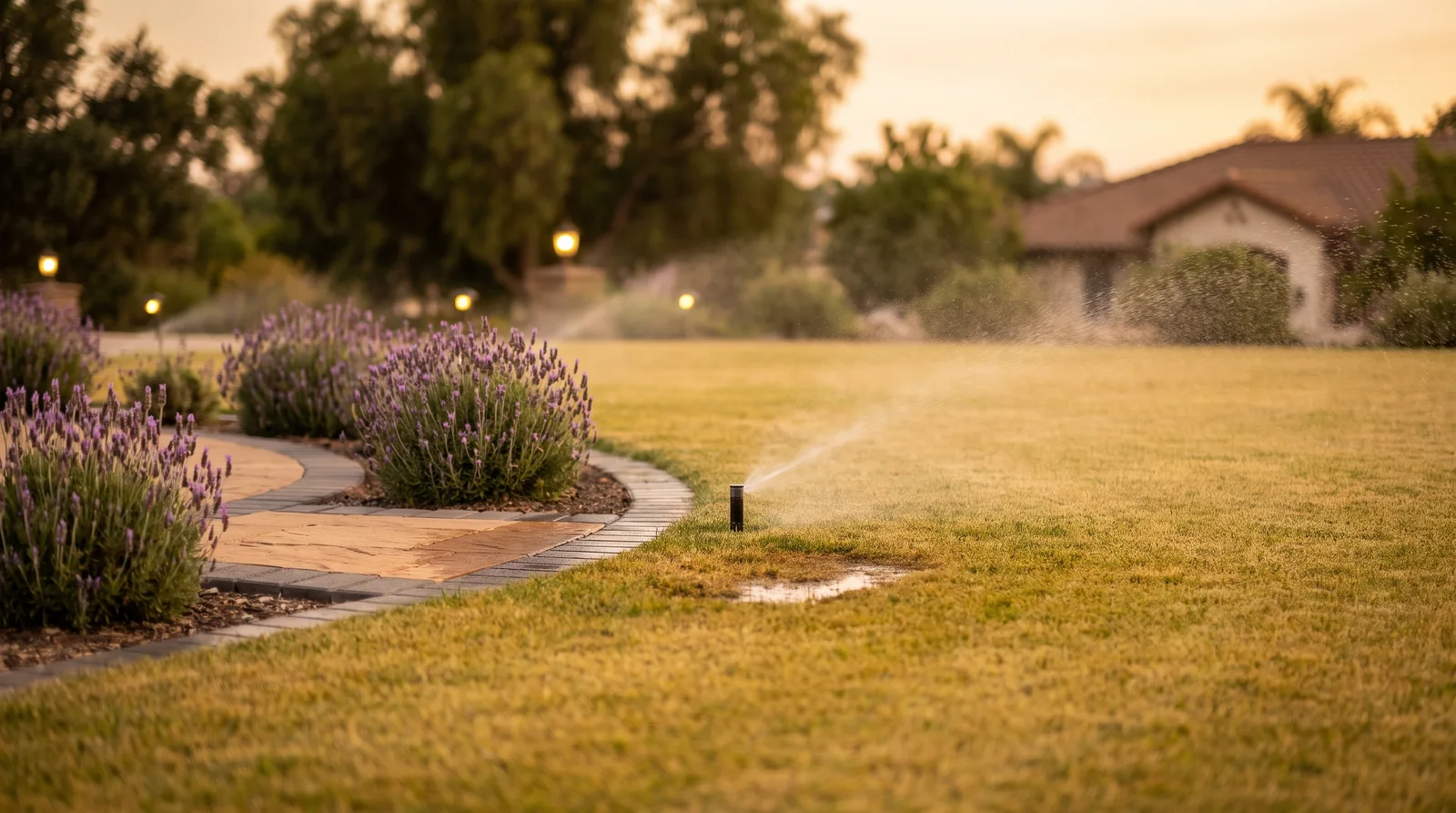
Escondido's code defines this as low head drainage: a head that keeps emitting water after its zone shuts off. The usual causes are a worn check valve in the head, a debris-fouled zone valve, or a head sitting at the low point of a sloped zone so the pipe drains out of it. A pool of water at the lowest head after every cycle is the giveaway.
Brown patches and dry zones
Look for clogged nozzles first, then tilted heads, then mismatched nozzle types in one zone. Mixing spray and rotor nozzles on the same valve gives uneven coverage because they apply water at different rates. A zone that dries out near its edges often needs head spacing or nozzles corrected, not more run time.
Overspray on pavers, walls and driveways
Water on hardscape is wasted water, and it can stain pavers, undermine the base and run off the property. The city's design standards call for drip or subsurface irrigation within 24 inches of a hard surface unless it drains into the landscape, as laid out in Escondido's landscape code. Those standards apply to new and larger projects, but they are a good benchmark for any repair. Redirecting or swapping a few nozzles near an interlocking paver patio or wall is usually a small job.
How to find a hidden leak
Start with the meter. The EPA's Fix a Leak Week guidance says to read the meter before and after a two-hour period with no water use; any change means a probable leak. Turn off everything inside the house first, and run no sprinklers during the test.
Then check pressure. The EPA says service pressure much below 45 psi may point to a leak. A pressure gauge that screws onto a hose bib costs little and tells you a lot.
Small leaks add up. EPA's leak fact sheet says a leak 1/32 inch wide, about the thickness of a dime, can waste about 6,300 gallons a month. Fixing easily corrected leaks can cut bills by about 10%, according to EPA's leak facts.
Know where to stop. Replacing a head or nozzle is a reasonable DIY job. Digging near a main line, a buried valve manifold, or pipe that runs under a driveway is better left to a pro, because it's easy to turn a small leak into a big one.
A seasonal irrigation check that actually fits San Diego
Monthly: run each station and look for broken or misaligned heads. This is the city's own advice on its conservation page.
Spring: do a full spruce-up. The EPA recommends checking for winter damage, making sure sprinklers aren't hitting pavement or hardscape, and checking that drip lines aren't clogged or leaking.
Each season change: adjust the schedule. Cooler months need far less water than summer, and rain means the system should stay off for 48 hours.
Twice a year: check head alignment, even with a smart controller. The County of San Diego makes this point on its smart controller page, which also says Californians use 30-60% of their water outdoors and that as much as half of it is wasted.
If water runs off before the cycle ends: split the run time. Water for half the time, wait about an hour, then water the rest. Clay soil especially needs this.
A soil probe or long screwdriver tells you whether water is reaching the root zone. If you are thinking about a controller upgrade, our guide to smart irrigation controllers for San Diego yards covers types, sensors and rebate fine print.
Irrigation leak or drainage problem?
Soggy ground looks the same whether it comes from a broken line or from water that has nowhere to go. The difference is timing. If the wet spot appears only after a sprinkler cycle and the meter test shows movement, suspect irrigation. If it shows up after rain, stays wet for days, or sits at the base of a slope or wall, suspect drainage.
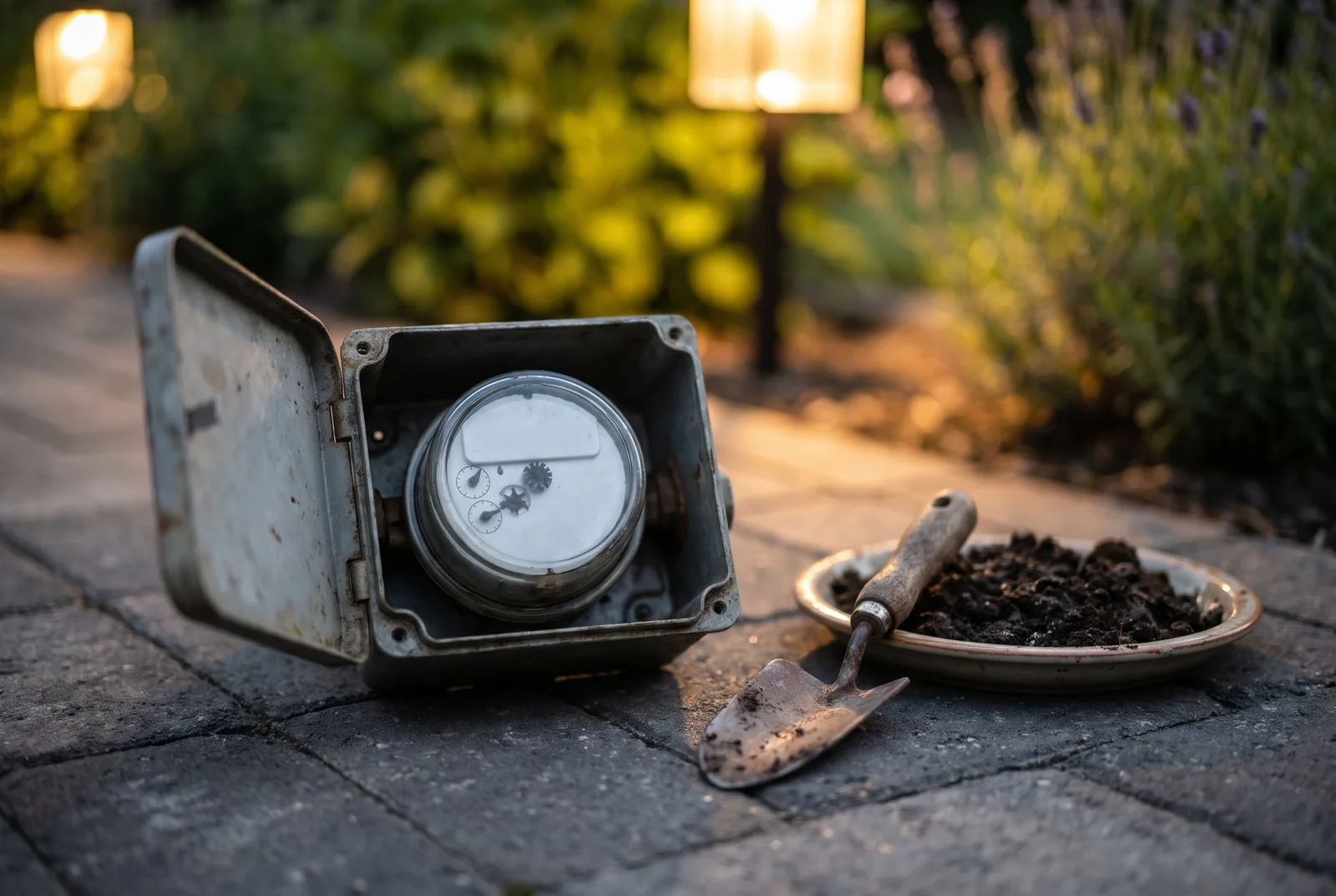
We see this often: a homeowner replaces sprinkler pipe twice when the real issue is poor grading or a blocked drain. Compacted or poorly prepped soil makes it worse, since water can't percolate. If you suspect drainage, start with our guides to drainage correction in North County and drainage repair.
Repair, rebuild or upgrade?
Patching makes sense when problems are isolated: a few heads, one valve, one cut line. It stops making sense when you keep chasing new leaks in old pipe, when zones mix plant types, or when coverage is uneven no matter what you adjust.
Convert planting beds to drip, which puts water at the roots and avoids overspray.
Match nozzles within each zone so every head applies water at the same rate.
Rezone so turf, shrubs and slopes each get their own valve and schedule.
Add a weather-based or soil-moisture controller. The County says rebates require a WaterSense-certified model, and the EPA says WaterSense-labeled products are independently certified to use at least 20% less water.
Rebates change often. The SoCal Water$mart program has listed controller rebates of $80 per controller or $60 per station depending on landscape size, but confirm the current amount before you buy. The county's own controller rebate is limited to unincorporated areas, so check your address. The Water Authority's free irrigation checkups are for qualifying non-residential properties, not homeowners.
Working with AJ Criss Industries
AJ Criss Industries is a family-run crew serving Escondido and North County. We diagnose before we dig: meter and pressure checks, a station-by-station walk, and a look at grading and soil. If the answer is a new head, that's what we'll tell you. If it's a rebuild, we'll explain why. See our sprinkler and irrigation work, read about planning a new install, or get a quote.
Planning driveway, paver or turf work? Tell us first. Lines should be protected, and pipe under a driveway belongs in conduit so it can be repaired without tearing up the surface.
Frequently asked questions
When can I water in Escondido?
Irrigation is allowed only between 6 pm and 10 am under the city's conservation rules. Rules can tighten with water-shortage levels, so check the city's page for the current status.
Can I water after it rains?
No. Escondido prohibits watering during rainfall or within 48 hours of rain. A rain sensor or weather-based controller handles this automatically.
How often should I check my sprinklers?
Run each station monthly and look for broken or misaligned heads, as the city recommends. Do a fuller check each spring and adjust the schedule when seasons change.
Who do I call about a leak or water waste?
Fix leaks on your own system right away, since the city requires prompt repair. To report waste elsewhere, call Escondido Public Works at 760-839-4668.
Is a smart irrigation system worth it in San Diego?
It can be, if the zones, nozzles and pressure are right first. A smart controller can't fix a leaking valve or mismatched heads, which is why we check the system before recommending an upgrade.
Check it now, not after the water bill
Most sprinkler problems are cheap to fix when caught early and expensive when ignored. Run your stations this week, do the meter test, and note anything that mists, drips or pools. If the cause isn't obvious, or you suspect drainage, give us a call at AJ Criss Industries and we'll find out what's really going on.
Sources
Water Conservation — City of Escondido
Home Maintenance — U.S. Environmental Protection Agency
Epa — U.S. Environmental Protection Agency
Article 5: WATER CONSERVATION PLAN - City of Escondido ... — City of Escondido
Article 62: WATER EFFICIENT LANDSCAPE REGULATIONS - City of Escondido, CA — City of Escondido
Fix a Leak Week - WaterSense — U.S. Environmental Protection Agency
Fix a Leak Week Fact Sheet — U.S. Environmental Protection Agency
Leak Facts — U.S. Environmental Protection Agency
Smart Irrigation Controllers — County of San Diego
16th annual Fix a Leak Week reminds businesses to reduce water waste — U.S. Environmental Protection Agency
SoCal Water$mart's Smart Irrigation Controller Program — County of San Diego
B usinesses, public agencies and institutions have — San Diego County Water Authority