
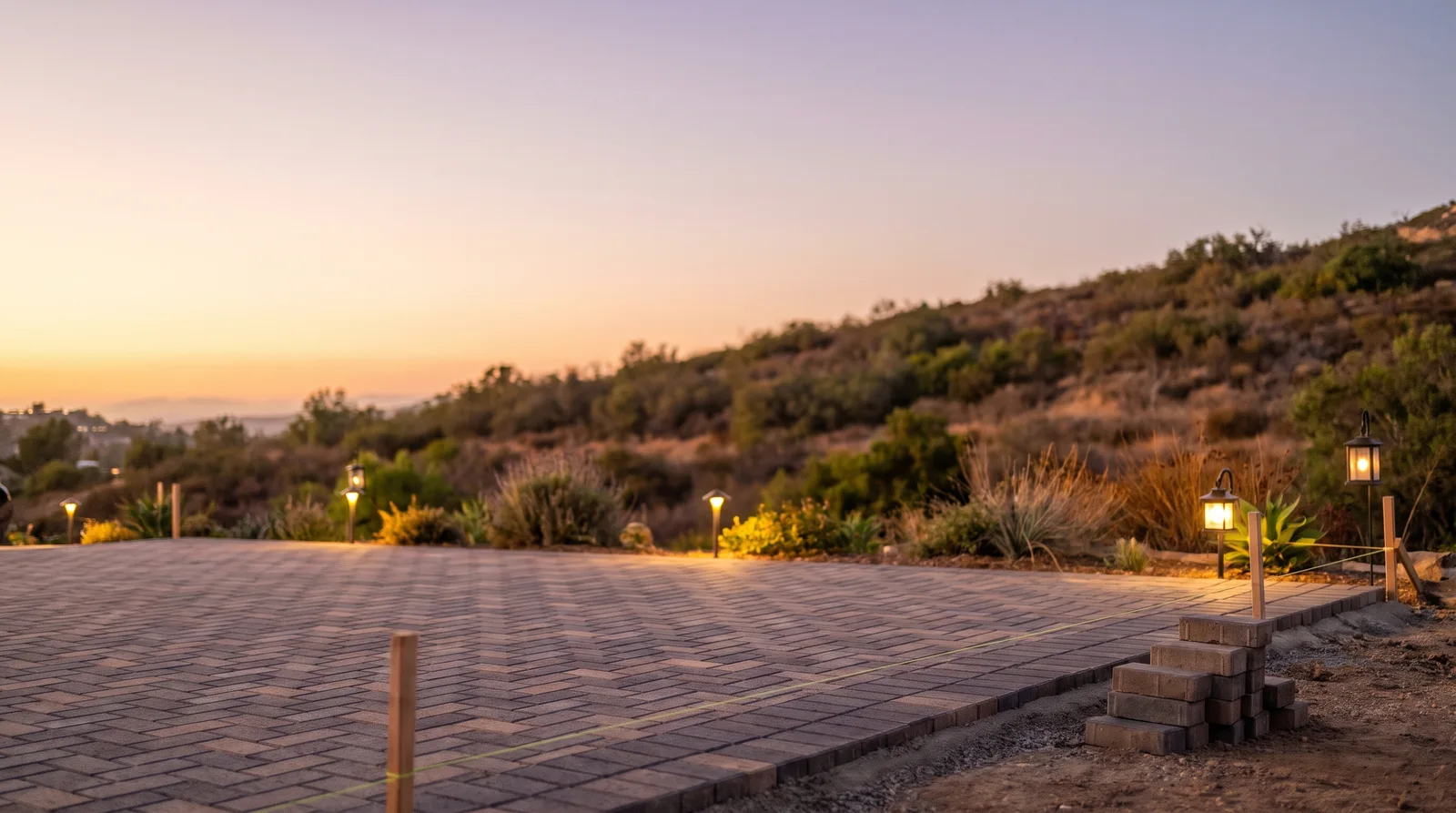
 interlocking pavers
Interlocking Paver Installer in North County: What to Ask
Anthony Criss · November 24, 2026
Key takeaways
A good paver installer holds a CSLB license and writes base depth, edging and sand specs into the contract.
Pavers fail from below and from the sides, so base prep and edge restraints matter more than the paver you pick.
Industry guidance calls for at least 4 in. of compacted base under patios and 6 in. under residential driveways on well-drained soils.
Bedding sand is not a leveling tool. An uneven base has to be fixed before the sand goes down.
Three bids only compare fairly if each one lists the same base, edging and drainage details.
The best interlocking paver installer for your yard is a licensed contractor who can tell you, in numbers, how deep the base will be, how it will be compacted and how the edges will be held. Pavers rarely fail on the surface. They fail from below, when the base shifts or drains poorly, and from the sides, when nothing holds the edges.
Here is what that looks like on a North County job, what to ask before you hire, and how to compare bids. If you want us to look at your patio or driveway, our interlocking pavers page shows the work we do.
Check the license before anything else
California law is clear on this. Under the Contractors State License Board's hiring guide, any contractor doing work worth $1,000 or more, labor and materials combined, must be licensed. Any job that needs a permit or workers also requires a licensed contractor.
Look up the license number on the CSLB website, ask to see the pocket license and a photo ID, and confirm the license covers this type of work. CSLB also warns about unlicensed workers, who rarely carry a bond or workers' compensation.
Ask for proof of workers' compensation and general liability insurance.
Ask who pulls any permits.
Pay no more than 10% down or $1,000, whichever is less.
Put everything in a signed contract, including cleanup and debris removal. Change orders should be written and signed by both sides.
Our guide to choosing a landscaping contractor in North County goes deeper on bids and payments.
Base prep: the part you can't see
When a contractor says "proper base prep," ask what that means. The industry guidance is specific. ICPI's Tech Spec 2 lays out the sequence: layout, excavating and compacting the soil subgrade, optional geotextile, spreading and compacting the base, edge restraints, bedding sand, then pavers. These are industry guidelines, not law, but they are a fair yardstick for any bid.
Excavation and subgrade
Organic material, roots, debris and rocks come out and get replaced with clean, compacted aggregate. The soil underneath is then compacted. ICPI calls subgrade compaction critical and sets a target of at least 98% of standard Proctor density. On very wet or very fine soils that target may not be reachable, and the subgrade may need stabilizing first.
Base depth and compaction
The same guidance calls for at least 4 in. of compacted base under patios and walkways on well-drained soils, and at least 6 in. under residential driveways. It notes that thicker bases are often used on expansive soils. The base goes in and is compacted in 4 to 6 in. lifts, not dumped in one pass, and each lift is compacted at the right moisture.
Sand is not a leveling tool
Bedding sand goes down at about 1 in. If the base is uneven, the sand cannot hide it. The low spots show through over time, so the base itself has to be corrected first. ICPI sets a flatness tolerance of plus or minus 3/8 in. over a 10 ft straightedge. Ask whether your installer checks it.
Drainage and clay soils
Water is what moves a base. ICPI says geotextile fabric can be used over clay and moist silty soils, or where the ground stays saturated part of the year, to keep soil from migrating up into the base. For vehicle areas on clay or other slow-draining soils, it recommends perforated drain pipe in open-graded stone wrapped in fabric.
In our experience around Escondido, the cause of a sinking patio is often water that was never dealt with, not the pavers themselves. We look at where roof runoff and slope runoff go before we quote a base. If you already have standing water, start with drainage correction in North County or our drainage installation service.
Edging: what keeps pavers together
Pavers hold their pattern because they interlock, and edge restraints keep that interlock from spreading apart. ICPI says restraints can be aluminum, steel, plastic or concrete, and that at least 1 in. of vertical restraining surface must touch the side of the paver. Their elevations should be checked before sand and pavers go in.
Ask your installer which restraint they use, how it is fastened and how far the base extends past it. A line like "edging included" is not enough.
The finish: compaction, joints and normal settling
Once pavers are laid, they are compacted with a plate compactor, at least two passes. Dry joint sand is swept in and the surface is compacted again until the joints are full. Joints should be consistent, between 1/16 and 3/16 in. Gaps wider than 3/8 in. get filled with cut pavers rather than extra sand.
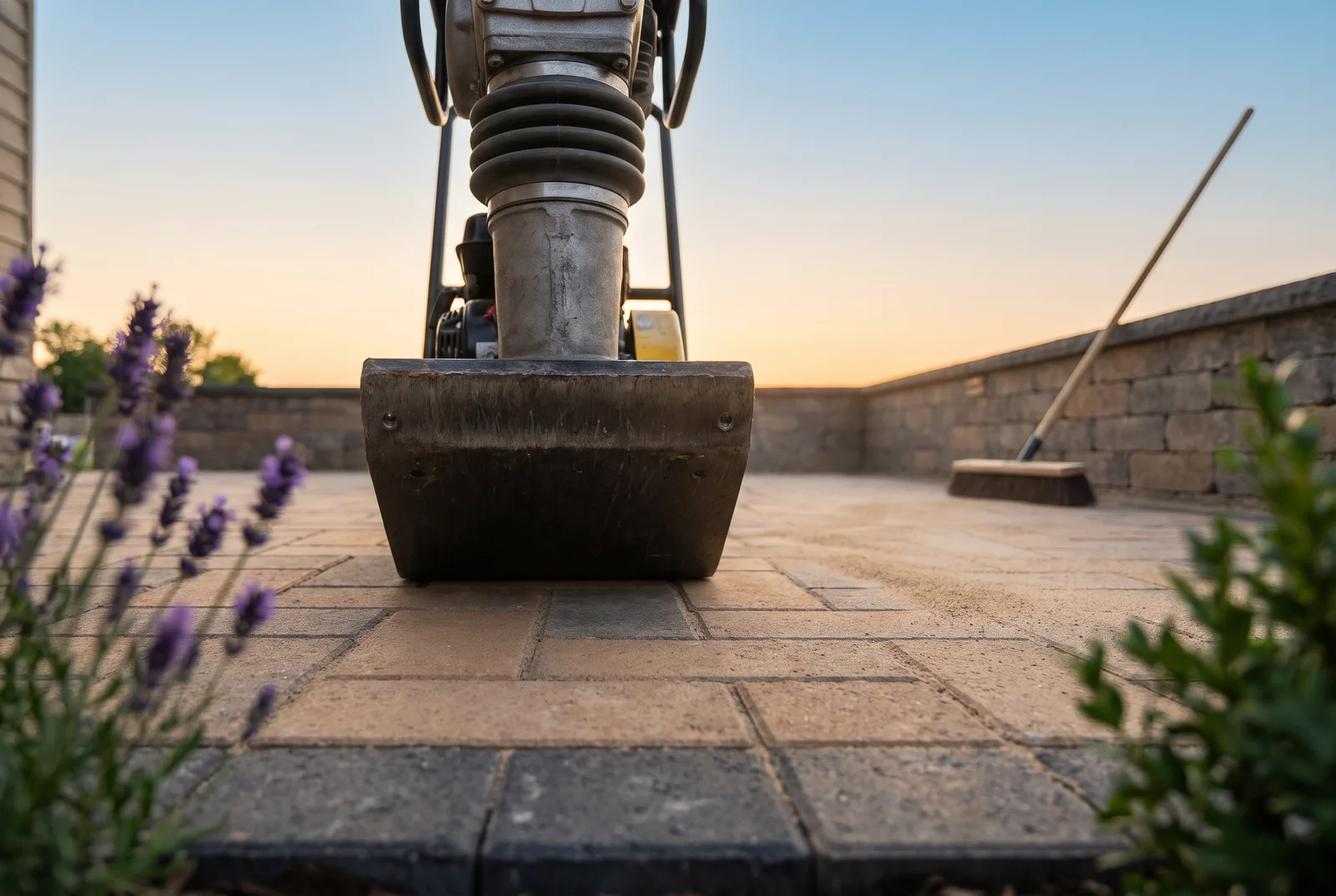
Some settling is normal. ICPI notes that pavers may be set 1/8 to 1/4 in. proud of final grade to allow for it, and that a small amount of settling is expected in flexible pavements. Dips, rocking pavers or open joints are not normal. A warranty should say which problems it covers.
What to ask an installer
What is your CSLB license number, and can I look it up?
Do you carry workers' compensation and liability insurance?
How deep will the excavation be, and what base material will you use?
How do you compact the subgrade and base, and in what lift thickness?
What edge restraint will you use, and how is it fastened?
How will you handle drainage, and is fabric or a drain needed on my soil?
What sand goes under the pavers?
Who pulls permits, if any are needed?
What does your warranty cover, in writing?
What is the payment schedule?
How to compare three bids
CSLB suggests getting at least three bids, but they only help if they match. One bid with a 6 in. base and another with a thin one are not the same price for the same job. Send each contractor the same scope and ask them to write down base depth, edge restraint, sand and drainage work.
Tie payments to finished phases, and keep the deposit within CSLB's limit. If you're weighing materials first, see our comparison of pavers vs concrete driveways.
Frequently asked questions
How thick should the base be under a paver patio?
ICPI guidance calls for at least 4 in. of compacted base under patios and walkways on well-drained soils. Driveways need at least 6 in. Clay or expansive soils often call for more.
Do I need a licensed contractor for a paver patio?
In California, any job of $1,000 or more in labor and materials requires a licensed contractor. Most paver patios clear that easily. Check the license on the CSLB site before you sign.
Can sand fix an uneven base?
No. ICPI says bedding sand must not be used to make up for an uneven base because the problem shows through over time. The base has to be corrected first.
Is some settling normal after installation?
A small amount is normal, which is why pavers are often set slightly above final grade. Ongoing dips, loose edges or widening joints point to a base, drainage or edging problem.
Hire for what's under the pavers
A good paver job comes down to licensing, base prep, drainage and edging, all written into the contract. If you're in Escondido or elsewhere in North County, AJ Criss Industries can walk your site, explain what the soil and drainage call for and give you a bid you can compare. Get a quote and we'll set up a visit.
Sources
CONTRACTORS STATE LICENSE BOARD Department of Consumer Affairs — Contractors State License Board (CSLB)
What Kind of Contractor Do You Need? - CSLB - CA.gov — Contractors State License Board (CSLB)
Tech Spec 2 — Interlocking Concrete Pavement Institute (ICPI)