
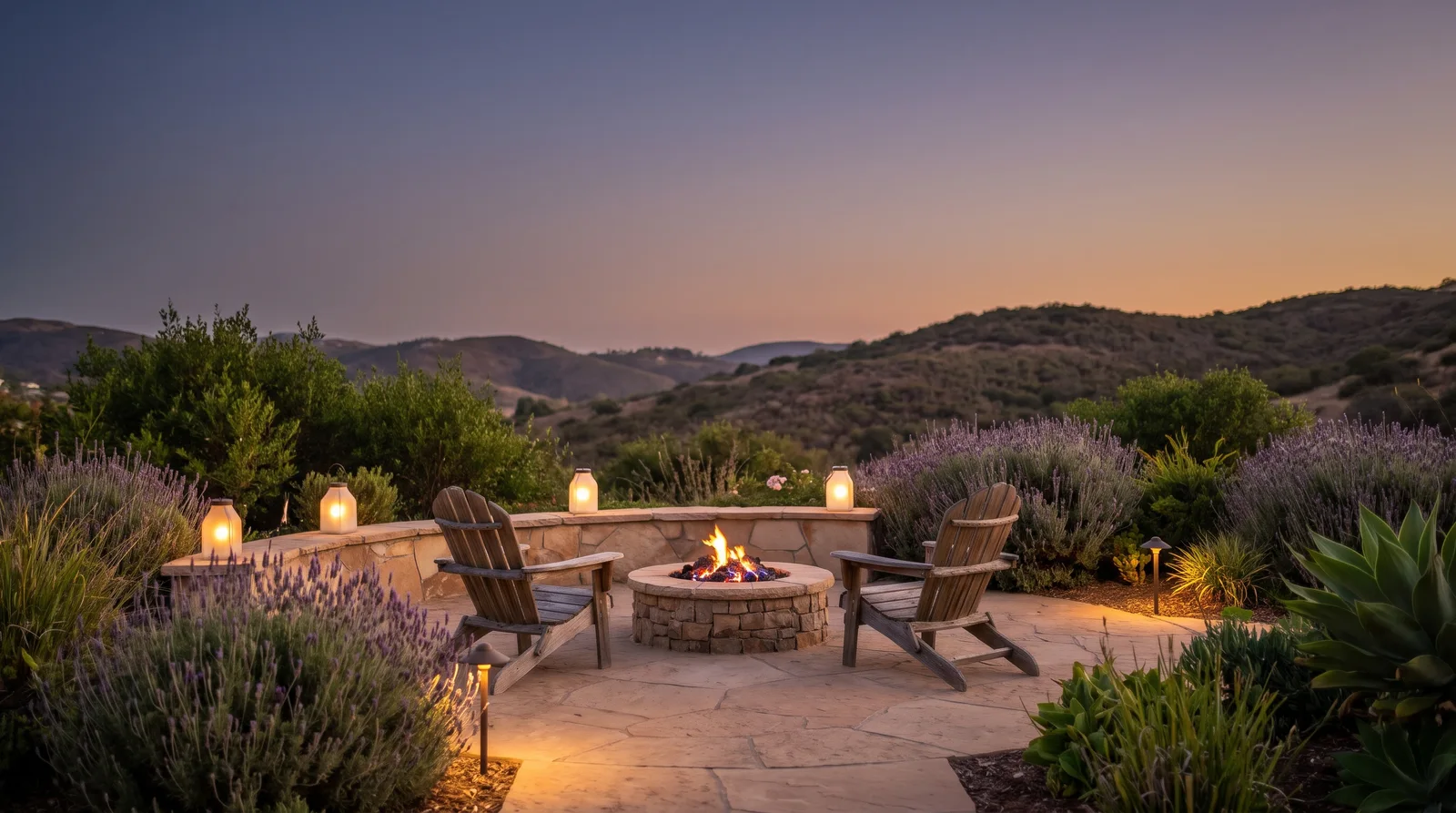
 fire pit installation
Fire Pit Installation in North County: Rules and Planning
Anthony Criss · November 13, 2026
Key takeaways
In Escondido, a permanently installed fire pit is permitted as a natural gas or propane unit, not as a wood-burning one.
Clearance figures of 10, 15 and 25 feet all appear in official guidance. Which one applies depends on your city, your fuel and the type of fire.
Call your fire department first for clearances and location approval, then the building department for permits.
A fire pit patio is only as good as its base, so drainage and compaction matter as much as the stone you see.
Treat the pit as hot long after the flames are out, because many injuries come from embers the next day.
In Escondido, a permanent fire pit is built as a permitted natural gas or propane unit, set back from anything that can burn, with the fire department and building department deciding the details. Wood fires are limited to listed portable fireplaces. Rules differ across North County and Greater San Diego, so confirm yours with your local fire authority before you build.
This guide explains what the official sources say, how to choose between gas and wood, how to plan the layout, and what a patio base needs to hold up. We build fire pits and patios across North County at AJ Criss Industries, and we'd rather you know the rules before you sign anything. See our fire pit installation work if you want to see what we build.
What the rules say in North County
There is no single North County fire pit rule. Each city and the unincorporated county set their own, and most online guides blur them together. Here is what the official sources say.
Escondido gas or propane pits: Escondido Fire's portable fireplace handout says they must not be within 10 feet of combustible walls, roofs, other combustible materials or vegetation, including ornamental plants. The same handout says wood-burning pits need 25 feet and a spark arrestor or screen.
County portable fireplaces: the County's 2026 Consolidated Fire Code says portable outdoor fireplaces must stay 15 feet from a structure or combustible material, with an exception for those used at one- and two-family dwellings.
City of San Diego recreational fires: a small wood fire must be at least 25 feet from a structure and constantly attended, according to San Diego Fire-Rescue. That is a city rule, not an Escondido one.
National guidance: the U.S. Fire Administration says to keep fire pits at least 10 feet from the home or anything that can burn.
Why the numbers differ: 10 feet is a baseline for gas and general safety, 15 feet applies to portable units, and 25 feet is the figure used for open wood fires. When two numbers could apply, design to the larger one if your yard allows it.
One caution: Escondido's portable fireplace handout cites an older fire code edition and isn't dated. Call Escondido Fire at 760-839-5400 to confirm current requirements for your lot.
Gas or wood: what fits your yard
In Escondido the choice is mostly made for you. The city's Guidelines for Outdoor Fires say building permits are only issued for fire pits using natural gas or propane, and that permanently installed, permitted pits are not designed for wood burning. A backyard wood fire without a permit is allowed only in a UL-listed, State Fire Marshal-approved portable fireplace with a screen, door, lid or spark arrestor, set above ground. The handout says chiminea types do not qualify.
That shapes design. If you want a built-in stone or paver pit, plan it around a gas burner and a gas line or propane supply. If you want to burn wood, plan space for a listed portable unit instead.
On air quality, the San Diego County Air District says it does not currently prohibit burning in fireplaces, fire pots, fire rings, grills or chimineas. It also notes that home wood burning is a growing source of air pollution in the county. Gas avoids that issue, and it's easier on neighbors.
Wood burners also need a spark arrester. The County fire code calls for a screen mesh of one-half inch or smaller on wood warming fires, or use in line with the manufacturer's instructions.
Who to call, and in what order
Three agencies answer three different questions, and homeowners often call the wrong one.
Your fire department: clearances, hazardous fire area status and location approval. In Escondido, the city's residential zoning code lists outdoor fireplaces as permitted accessory uses, but within required setbacks only with prior approval of the fire chief or designee. It also keeps them at least five feet from a retaining wall or toe of slope and limits their aggregate area to 40% of the rear setback.
Your building department: permits. Requirements vary by city and by whether the unit is gas or wood, so ask before you dig. In Escondido, permanently installed pits must have had building permits issued at construction. Gas lines may also bring plumbing or other trade permits.
The air district: only relevant if you plan to burn wood, and as above it does not currently prohibit it.
Also check whether your lot is in a hazardous fire area. Escondido says outdoor fires are not permitted there, including on property adjacent to wildland. If your yard backs onto open brush, ask before you design anything. Our piece on California's Zone Zero rule covers the related rules around the home itself.
Planning the layout

Clearances and overhead structures
Start with the clearance you need, then add margin. Measure from the pit's edge to walls, fences, eaves, plants and anything else that can burn. Landscaping counts: Escondido's 10-foot gas rule includes ornamental plant material, so a hedge near the pit is a problem.
Patio covers and pergolas are a separate question. We found no official overhead clearance number for San Diego, so don't rely on a rule of thumb from a website. For a gas unit, follow the manufacturer's manual and ask the fire department before you build a cover above a pit. If you want both, we can plan the patio cover and deck and the pit together.
Seating, wind and sight lines
From our field experience, the best pits sit where evening breezes don't push smoke or heat toward the seating or the house. Leave enough room to walk around the seating without brushing the pit. A sitting wall can double as a seat and a wind break. Low-level lighting along paths also keeps people from stumbling near a hot surface after dark.
Gas line routing and slope
A gas pit needs a supply line, and the route should be planned before the base goes in, not after. The line should be installed by a licensed professional, and we'll confirm with you how that part of your project is handled during the quote. On sloped lots, the pit and seating area need a level pad, which may mean a retaining wall, and Escondido's code keeps pits at least five feet from a retaining wall or toe of slope.
Patio base and materials
Most fire pit patio failures start underground. Base depth depends on traffic, soil type, drainage and moisture, and the base has to be compacted in layers, not dumped and raked. A thick layer of bedding sand doesn't make up for a weak base, because the sand is only a thin leveling course.
Many North County yards have clay-heavy soil that holds water and moves. In our experience those yards often need a deeper base and drainage work first. Water pooling around a pit shortens the life of any patio. If your yard puddles, read about drainage correction in North County before choosing materials.
Choosing materials
Interlocking pavers: flexible, repairable and available in many styles. See our interlocking pavers page.
Slate and flagstone: natural texture that suits a rustic or modern pit, and a common choice for pit surrounds.
Stained concrete: a clean, seamless surface that can be colored to match the house.
For heat tolerance near the burner, follow the pit or burner manufacturer's documentation for the materials it approves. We didn't find an independent source rating these surfaces for heat, so treat any broad claim you read online with caution. A fire pit belongs on masonry, whether pavers, concrete or stone, not on a wood deck.
Safety habits that matter
Never leave it unattended. San Diego Fire-Rescue's recreational fire page requires constant attendance with a fire extinguisher or other equipment such as a garden hose, sand or water ready to use.
Use a metal screen over wood fires, watch children closely, and shut off or extinguish the fire before leaving the yard, per the U.S. Fire Administration.
Keep a children and pet buffer. AAA's insurance magazine, citing NFPA, reports that injuries from patio hearths and fire pits have risen, with children under 5 and pets most vulnerable, and many injuries happen the next day from still-hot embers.
Store any firewood away from the structure. Firewood storage rules vary by fire zone, so ask your fire authority.
Common questions
Do I need a permit for a fire pit in North County?
It depends on your city and the type of pit. In Escondido, a permanently installed pit must have had building permits issued at construction, and permits are only issued for gas or propane units. Other cities differ, so ask your local building department before you start.
Can I burn wood in my backyard fire pit in Escondido?
Only in a UL-listed, State Fire Marshal-approved portable fireplace with a screen, door, lid or spark arrestor, set above ground. The city's handout says permanently installed, permitted pits are not designed for wood burning, and outdoor fires aren't permitted in hazardous fire areas.
Can I put a fire pit on a wood deck?
We don't recommend it. A pit belongs on masonry such as pavers, concrete or stone. If you want a fire feature near a deck, we can build a masonry pad beside it with the clearances the fire department requires.
How far should a fire pit be from my house or fence?
Escondido says 10 feet from combustibles and vegetation for gas or propane pits, and 25 feet for wood. The county fire code says 15 feet for portable units. Check with your fire department, because fences and walls can count as combustibles.
Do you install fire pits near me in San Diego and North County?
Yes. We build fire pits and patios in Escondido, across North County and in Greater San Diego. Send us your yard details through our quote page and we'll talk through location, materials and what your city requires.
Plan it right before you build
A good fire pit patio comes down to four things: the right fuel for your city, enough clearance, a base that handles your soil and drainage, and safe habits once it's built. Call your fire department first, then your building department, and design to the stricter number when sources disagree.
If you're planning a fire pit and patio in Escondido or North County, get a quote from AJ Criss Industries and we'll walk the yard with you, talk through clearances and materials, and build it to last.
Sources
City of Escondido Fire Department 1163 N Centre City Parkway — City of Escondido Fire Department
COUNTY OF SAN DIEGO 2026 CONSOLIDATED FIRE CODE 9th Edition — County of San Diego
Recreational Fires — City of San Diego Fire-Rescue
Outdoor Fire Safety - USFA.FEMA.gov — U.S. Fire Administration
CITY OF ESCONDIDO FIRE DEPARTMENT 1163 N Centre City Parkway — City of Escondido Fire Department
Open Burning - San Diego County Air District — San Diego County Air Pollution Control District
Article 6: RESIDENTIAL ZONES - City of Escondido, CA — City of Escondido
Backyard Fire Pit Safety Tips - Your AAA Network — AAA Northeast (citing NFPA)